1. OOG Cargo
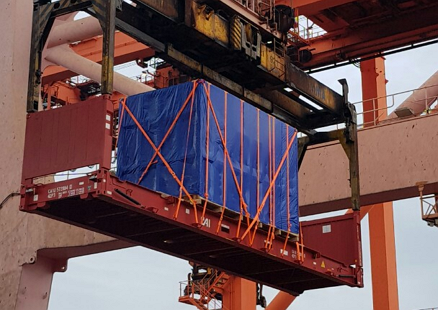
OOG cargo refers to cargo that exceeds the standard stuffing limits of a general dry container but can still be stuffed into a single flat rack or open top container and shipped on a container vessel.
OOG cargo typically applies in the following cases:
① The cargo length, width, or height exceeds the stuffing limits of a standard dry container;
② The cargo weight exceeds the maximum payload of a standard dry container, or the load is concentrated on a limited floor area, resulting in stuffing limitations.
Detailed Classification of OOG Cargo
OOG cargo is further classified based on the type of out-of-gauge condition and the need for non-standard handling methods.
In-Gauge Cargo
Cargo that does not protrude beyond the container footprint at the time of stuffing, and therefore does not generate void space during stowage.
Over-Length Cargo
Cargo that protrudes beyond the front or rear of a flat rack container after stuffing.
UC Cargo (Un-Containerized)
A sub-classification of OOG cargo used by certain container terminals, referring to cargo that cannot be handled using standard terminal equipment, and therefore requires additional resources such as wire slings, special lifting gear, and extra manpower.
Examples include:
Cargo whose over-height exceeds the allowable working limits of an OH frame;
Cargo positioned too close to the corner castings, making handling with an OH frame impractical.
2. Break Bulk Cargo
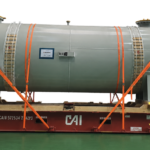
Break bulk cargo refers to cargo that cannot be stuffed and shipped using a single flat rack container due to excessive size, weight, or stuffing constraints.
If any of the following conditions apply, the cargo cannot be treated as OOG cargo, and a break bulk loading method must be considered:
① The cargo obstructs the flat rack corner castings, making lifting operations impossible;
② The cargo weight exceeds the maximum payload of the flat rack container;
③ The gross weight, including tare weight, exceeds the allowable working load of the terminal STS crane;
④ The cargo’s base support area extends beyond the flat rack floor;
⑤ The cargo load is excessively concentrated on a limited floor area.
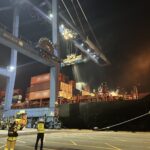
Because container vessels are capable of carrying not only standardized containers but also break bulk cargo, this method can be an effective transport solution for small-volume bulk-type cargo or in cases where bulk carrier schedules are unavailable or unsuitable.