Risk around the Strait of Hormuz is usually interpreted first as an oil market issue.
That is understandable. The most direct scenario is clear: tanker traffic is restricted, crude oil prices rise, and energy costs move higher.
But in this case, there is another important axis to watch: fertilizers.
The Strait of Hormuz is not only a key corridor for crude oil. It is also a critical route for nitrogen-based fertilizers such as urea and ammonia. The Middle East has developed into one of the world’s major urea production hubs, supported by low-cost natural gas, and these volumes have long moved to major agricultural regions across Asia, South America, and Africa.
In other words, a bottleneck in the Strait of Hormuz is not simply a disruption to energy transportation.
It should be seen as a supply-chain transmission risk that can disrupt fertilizer flows, raise agricultural production costs, and eventually affect grain and food prices as well as seaborne cargo volumes.
There are two key questions to consider.
First, how does a disruption in fertilizer supply affect the shipping market?
Second, through what channels does this shock feed into inflation?
1. The Starting Point: A Bottleneck in Fertilizer Exports
According to Kpler data, weekly fertilizer exports through the Strait of Hormuz have slowed sharply since March 2026. Previously, around 500,000 to 800,000 tons of fertilizer moved through the strait each week. Since then, volumes have fallen to levels close to the bottom.
The key point is not that the cargo has disappeared.
It is that the cargo is no longer moving.
Cargo can build up at ports, vessels can remain waiting, and even loaded ships may struggle to leave the Gulf region. This is one of the most disruptive forms of logistics stress. The cargo exists, but vessel circulation is impaired. The ships exist, but route risk makes normal operations difficult.
For the shipping market, this quickly translates into lower vessel operating efficiency.
When vessels wait, turnaround slows.
When turnaround slows, the amount of effective available tonnage in the market declines.
When available tonnage tightens, freight rates may come under upward pressure on certain routes.
However, freight rates do not necessarily rise uniformly across all routes.
Around Hormuz, risk premiums and waiting costs may rise. At the same time, if fertilizer shipments from the Middle East decline, bulk cargo volumes on those routes may temporarily fall.
Therefore, the short-term market reaction is not simply “higher freight rates.” It is more accurately a widening of route-by-route supply and demand imbalances.
2. Three Stages of Impact on the Shipping Market
The impact of fertilizer supply disruption on shipping can be divided into three broad stages.
The first stage is immediate shipment disruption.
If urea and ammonia cargoes from the Middle East cannot depart on schedule, bulk carrier operations on those routes are delayed. Shipowners may become reluctant to deploy vessels into high-risk waters, while charterers may have to bear additional costs reflecting insurance premiums and risk surcharges. In this process, fertilizer export volumes from the Middle East may contract in the short term.
The second stage is a change in ton-mile demand as buyers seek alternative suppliers.
Importing countries still need fertilizers. If they cannot secure sufficient volumes from the Middle East, they must look for other suppliers. Russia, North Africa, China, Southeast Asia, and parts of South America may emerge as alternative sources.
When the supplier changes, the route changes.
When the route changes, sailing distance changes.
When sailing distance increases, ton-mile demand rises.
In shipping, the important metric is not only cargo volume. It is cargo volume multiplied by distance — in other words, ton-miles. The same one million tons of cargo can generate very different vessel demand depending on whether it is sourced nearby or from a much more distant origin.
If Hormuz risk persists, fertilizer cargo volume itself may decline. Yet on some routes, alternative sourcing could increase ton-mile demand. This is what makes the shipping market response more complex.
The third stage is a delayed impact on agricultural export volumes.
Fertilizer is a core input for agricultural production. If fertilizer prices rise or supply becomes difficult to secure, farmers may reduce application rates, adjust planted acreage, or switch to crops that require lower input intensity.
This impact does not appear immediately.
It has to pass through planting, growing, harvesting, and export cycles.
But if yields eventually decline, agricultural export volumes such as grains, rice, and cotton may also be affected. Key export gateways such as the U.S. Gulf Coast, Santos and Paranaguá in Brazil, and grain ports in Argentina should be watched closely.
From a shipping market perspective, fertilizer shortages first appear as fertilizer transport disruption. Later, they may reappear as changes in agricultural export volumes.
3. Fertilizer Shortages Among U.S. Farmers
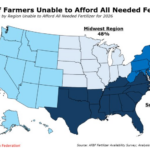
According to AFBF data, around 70% of U.S. farmers have been unable to secure all the fertilizer they need for the 2026 season. The situation is most severe in the South, where the figure reaches 78%.
The South matters because of its crop structure.
The region has a high concentration of input-intensive crops such as cotton, rice, and peanuts. Yet only 19% of Southern farmers pre-booked fertilizer, compared with 67% in the Midwest.
This means Southern farmers are much more exposed when fertilizer prices rise.
The shipping market should not view this only as an agricultural issue.
Fertilizer shortages in the U.S. South could eventually affect export volumes of cotton, rice, and certain grains. The impact may be reflected with a lag in bulk cargo flows through the Gulf of Mexico, one of the main gateways for U.S. agricultural exports.
Of course, fertilizer shortages do not automatically mean exports will fall.
Weather, inventories, government support, crop prices, and farmers’ substitution strategies all matter.
But the direction of risk is clear.
If fertilizer use declines, productivity may fall. If productivity falls, export availability may also decline. This can become a downside factor for the dry bulk market.
In other words, Hormuz risk can disrupt Middle East fertilizer shipments in the short term and, over the longer term, also affect agricultural export volumes from the United States and other major farming countries.
4. Brazil’s Restart of Urea Production
Against this backdrop, Brazil’s restart of urea production offers an important signal.
Brazil resumed urea production on April 30. Petrobras restarted the FAFEN Ansa plant in Araucária, Paraná, and the facility is currently producing around 2,000 tons of urea and 1,300 tons of ammonia per day.
The plant had been shut down in 2020 under the divestment policy of the Jair Bolsonaro administration. Since then, Brazil’s fertilizer import dependence has risen to around 80–90%.
Brazil is one of the world’s major agricultural exporters. It plays a significant role in global markets for soybeans, corn, sugar, meat, and other agricultural products. For a country with this profile, excessive dependence on imported fertilizers becomes a direct risk to agricultural export competitiveness.
This restart is not merely a factory reopening.
A facility that was previously shut down based on economic logic is now being brought back under a different standard: food security and supply-chain resilience.
From a shipping market perspective, this change has two implications.
First, part of Brazil’s fertilizer import volume could decline over the long term.
If domestic production increases, the need to import urea from overseas may be reduced.
Second, Brazil’s agricultural export base could become more stable.
If fertilizer supply becomes more secure, production of major export crops such as soybeans, corn, and sugar can be better protected. This would help support Brazilian bulk export volumes.
In other words, the fertilizer supply chain links inbound and outbound cargo flows.
Fertilizer imports may decline, but agricultural exports may be maintained. The shipping market needs to watch both directions at the same time.
5. The Inflation Transmission Mechanism
Another key part of this issue is inflation.
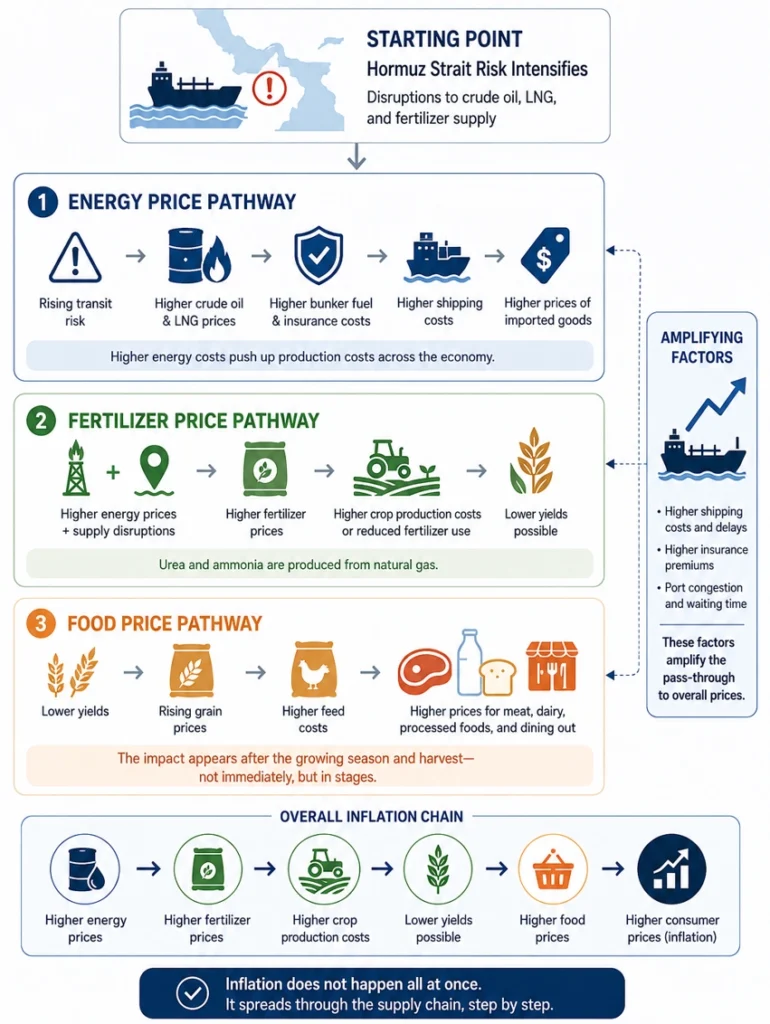
Hormuz risk can feed into inflation through three main channels.
The first is the energy price channel.
The Strait of Hormuz is a critical corridor for crude oil and LNG. If transit risk increases, crude oil prices, LNG prices, marine fuel costs, and insurance premiums may rise. Higher energy prices push up costs across almost every industry.
In shipping, higher fuel costs increase operating costs. These costs may then be passed on to shippers through freight rates or surcharges. When transportation costs rise, import prices also increase. This flow is reflected in consumer prices with a time lag.
The second is the fertilizer price channel.
Urea and ammonia are produced using natural gas as a key input. If energy prices rise and Middle East supply is disrupted, fertilizer prices increase. Farmers then have to buy fertilizer at higher prices or reduce application rates.
If farmers buy fertilizer at higher prices, agricultural production costs rise.
If they use less fertilizer, yields may decline.
Both outcomes can eventually create upward pressure on agricultural prices.
The third is the food price channel.
Fertilizer shortages do not immediately push food prices higher.
But the impact emerges through the growing and harvesting cycle. If yields decline, grain prices can rise. Higher grain prices can then feed into feed costs, meat prices, and processed food prices.
For example, if corn and soybean prices rise, feed costs increase. Higher feed costs can affect prices for chicken, pork, beef, and dairy products. If wheat and rice prices rise, pressure can also build on bread, noodles, ready-to-eat foods, and restaurant prices.
Inflation does not spread all at once. It spreads in stages.
Higher energy prices → higher fertilizer prices → higher agricultural production costs → potential yield decline → higher food prices → higher consumer prices
That is the basic flow.
6. How Shipping Costs Amplify Inflation
In the inflation transmission mechanism, shipping is not simply a means of transportation.
Shipping is both a channel of price transmission and an amplifier.
If fertilizers must be sourced from more distant suppliers, sailing distances increase.
If sailing distances increase, transportation costs rise.
If vessels must pass through high-risk waters, insurance premiums and risk surcharges are added.
If port congestion and vessel delays occur, demurrage and waiting costs also rise.
These costs are eventually reflected in cargo prices.
Fertilizer prices include not only production costs, but also freight, insurance, financing costs, and inventory costs. Agricultural prices work in a similar way. When production costs rise, export freight rises, and port delays increase, the landed cost for importing countries becomes higher.
Therefore, bottlenecks in the shipping market can amplify inflationary pressure rather than soften it.
This impact can be even greater for countries that rely heavily on food imports.
If grain prices rise at the same time as maritime transport costs and currency pressures, imported food price inflation can become more severe.
This is why Hormuz risk should not be seen only as a maritime security issue. It is also an inflation risk.
7. Implications for the Container Market
Fertilizers and grains are primarily bulk market issues.
However, they are not completely separate from the container market.
When food prices rise, consumers’ real purchasing power declines.
As spending on essential goods increases, households may have less room to purchase discretionary items such as apparel, electronics, and household goods. This can indirectly weigh on containerized cargo demand.
Agricultural products, processed foods, frozen foods, feed additives, and agricultural materials are also connected to container logistics. If fertilizer and agricultural supply chains become unstable, some containerized cargo flows may also change.
In other words, a shock that begins in the bulk market can later feed into consumer demand and container volumes.
Shipping is divided by vessel segment, but the real economy is connected.
Fertilizer is a bulk cargo. Yet the food price inflation and consumption slowdown that may follow can also affect the container market.
8. Key Indicators to Watch
To track this issue, it is not enough to follow only news about Hormuz transit.
Several indicators need to be watched together.
First, fertilizer export volumes through the Strait of Hormuz.
The starting point is whether Middle East urea and ammonia shipments normalize or remain delayed.
Second, fertilizer prices.
The key question is whether the rise in urea prices is only a short-term reaction or a structural move reflecting real supply tightness.
Third, fertilizer application rates and planted acreage.
In the United States, the USDA Acreage Report can provide an important signal. Because it reflects actual planted area, it helps show how much fertilizer price increases and supply disruptions have affected farmers’ decisions.
Fourth, cargo volumes at major agricultural export ports.
The U.S. Gulf Coast, Santos and Paranaguá in Brazil, Argentine grain ports, the Black Sea, and ports near the Middle East all need to be monitored together.
Fifth, ocean freight rates and insurance premiums.
In particular, it is important to watch risk premiums on Middle East-related bulk routes, ton-mile changes caused by alternative sourcing, and whether vessel waiting times increase.
9. Conclusion: Fertilizer Supply Chains Are the Invisible Link Between Shipping and Inflation
The core issue in the current Hormuz risk is not only crude oil prices.
If the Strait of Hormuz becomes blocked or unstable, not only crude oil and LNG flows but also fertilizer supply chains are affected. If fertilizer supply is disrupted, agricultural production costs rise and farmers may reduce input use. Over time, the effects appear in grain output, food prices, and agricultural export volumes.
For the shipping market, this shock is transmitted in three ways.
In the short term, it appears as delays in Middle East fertilizer shipments and vessel waiting.
In the medium term, it appears as changes in ton-mile demand as buyers seek alternative suppliers.
In the long term, it may appear as changes in bulk export volumes caused by potential declines in agricultural production.
From an inflation perspective, energy prices, fertilizer prices, agricultural production costs, and food prices are sequentially connected. Higher shipping costs and insurance premiums can further amplify this flow.
Brazil’s restart of urea production symbolically reflects this shift.
Facilities that were once shut down based on economic logic are now being restarted in response to food security and supply-chain risk. This suggests that countries are beginning to view fertilizers not merely as agricultural inputs, but as strategic infrastructure supporting agricultural exports and price stability.
Ultimately, Hormuz risk does not end inside the strait.
Fertilizer that is blocked at sea is transmitted to the farm. Lower productivity on the farm is transmitted to food prices at the table. And the entire process is transported, priced, and reflected again through the shipping market.
Shipping markets and inflation do not move separately.
When cargo stops, costs rise.
When costs rise, prices rise.
And when prices rise, cargo flows change again.
This is why the current fertilizer supply-chain issue should not be viewed simply as a commodity price story. It is a structural case of how shipping markets and inflation are connected.