[Tech Insight] Dry Container Load Limits: Loading Heavy Coils
August 19, 2026
The fact that a Dry Container has a maximum payload of 28 tonnes does not mean that a single 20-tonne Coil can be loaded into it. The maximum payload is the limit for the combined weight of the cargo and all securing materials loaded into the container. Cargo such as a Coil, however, has a
[Tech Insight] Heavy Cargo Loading on a 40′ Flat Rack: Understanding Point Loads and Load Distribution
August 15, 2026
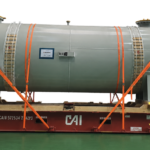
The fact that the 40′ Flat Rack states a maximum payload of 47 tonnes does not mean that any 47-tonne cargo, regardless of its configuration, can be loaded without further evaluation. The actual permissible cargo weight depends not only on the total cargo weight, but also on where the load is applied, the spacing between
On the morning of February 28, 2026, a fire caused by spontaneous combustion was discovered in a container loaded with charcoal aboard a 20,738-GT container vessel sailing from Incheon to Gwangyang. 1. Incident Details 1) Vessel involved: 1,800-TEU container vessel 2) Location: KIT Terminal, Gwangyang Port 3) Incident description:On February 28, 2026, while the vessel
[Market Insight] Hormuz Risk and the Fertilizer Supply Chain – How Are Shipping Markets and Inflation Connected?
May 10, 2026
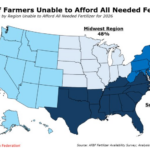
Risk around the Strait of Hormuz is usually interpreted first as an oil market issue. That is understandable. The most direct scenario is clear: tanker traffic is restricted, crude oil prices rise, and energy costs move higher. But in this case, there is another important axis to watch: fertilizers. The Strait of Hormuz is not
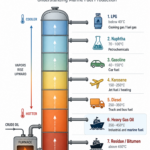
Crude oil is separated through fractional distillation based on boiling points. Lighter products such as LPG, naphtha, and gasoline rise to the top, while heavier products like diesel, fuel oil, and residue remain at the bottom. What looks like a basic chemistry concept is actually the starting point for understanding today’s energy markets. The U.S.
[Market Insight] Hormuz Risk and the Hidden Capacity Shortage – Why the Market Is Still Supply Tight
May 1, 2026
Looking at the World Container Index, the recent decline in rates should be interpreted not as a sign of market weakness, but as a correction on top of a structurally tight supply environment. The container market remains supply tight.With idle capacity at only around 0.7%, the global fleet is effectively fully utilized. However, geopolitical risks
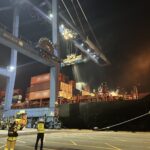
BPT Sinseondae-Gamman Terminal at Busan Port has recently introduced additional ARMGC units. * ARMGC stands for Automated Rail Mounted Gantry Crane. It is an automated yard crane that runs on rails and handles containers in the yard without an onboard operator. At first glance, this may look like a simple equipment upgrade, with several new
[Tech Insight] What Is the Difference Between OOG and Break Bulk Cargo in Container Shipping?
November 28, 2017
When handling oversized or heavy cargo in container transportation, practitioners frequently encounter the terms OOG (Out-of-Gauge) and Break Bulk cargo. However, depending on terminal conditions, carrier policies, container specifications, and vessel structure, the same cargo may be classified as OOG in one case and as Break Bulk in another. This often leads to uncertainty regarding