

On the morning of February 28, 2026, a fire caused by spontaneous combustion was discovered in a container loaded with charcoal aboard a 20,738-GT container vessel sailing from Incheon to Gwangyang.
1. Incident Details
1) Vessel involved: 1,800-TEU container vessel
2) Location: KIT Terminal, Gwangyang Port
3) Incident description:
On February 28, 2026, while the vessel was approaching Gwangyang Port, a fire was detected inside a container in the outer harbor. The relevant authorities were notified, and the vessel subsequently berthed at the terminal.
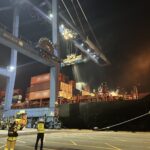
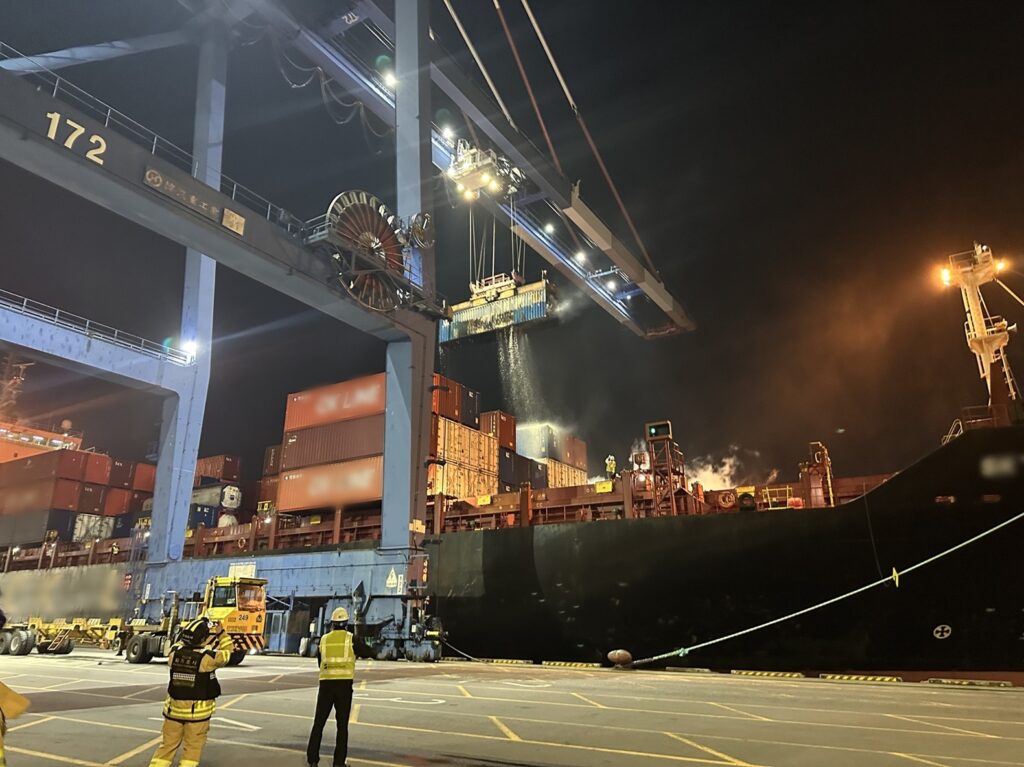
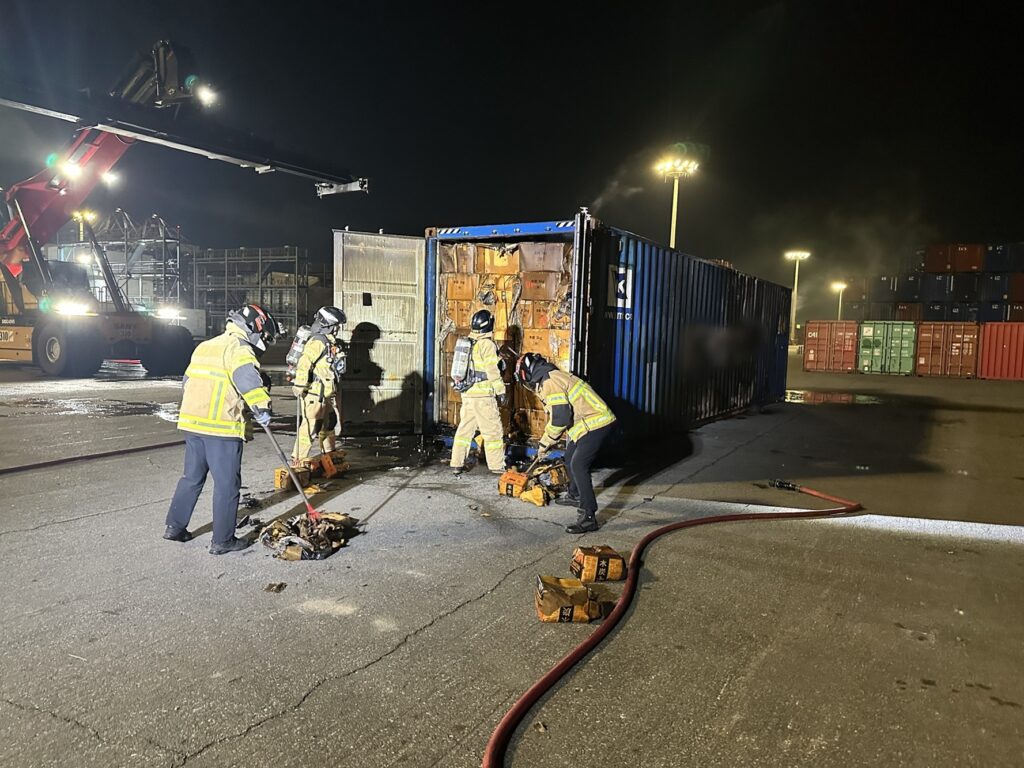
After berthing, the fire service and Korea Coast Guard attended the scene. The affected container was lowered into seawater using a terminal gantry crane to extinguish the fire.
4) Container information
- Actual contents: Charcoal
- Port of loading / discharge: Bangkok / Gwangyang
- Declared cargo description: Material for BBQ

2. Cargo Identification
Based on publicly available information alone, it is not possible to determine whether the cargo was declared as dangerous goods or whether any regulations were breached. Nevertheless, this incident clearly demonstrates where the first line of risk control in charcoal transport should begin.
A charcoal fire may start inside a container, but the first failure in accident prevention often occurs much earlier—when the cargo description is accepted without sufficient verification.
A description such as “Material for BBQ” may cover charcoal, charcoal briquettes, coconut-shell charcoal, firelighters, cooking utensils or other barbecue-related products. It describes the cargo’s intended use but does not identify what the product is made of or what hazards it may present.
If such a broad description passes through the booking process without further verification, actual charcoal cargo may be incorrectly treated as general or non-dangerous cargo.
The following descriptions should trigger additional screening for possible charcoal or carbon-based cargo rather than immediate acceptance as general cargo:
- Material for BBQ
- BBQ Fuel
- Fuel Briquettes
- Shisha or Hookah Products
- Coconut Products
- Carbon Products
- Water-pipe Tablets
The verification process should focus on the actual material and manufacturing process rather than solely on the product’s intended use.
- What is the actual material or substance?
- Is it produced from animal or vegetable materials such as wood, bamboo or coconut shells?
- Has the raw material undergone pyrolysis or carbonization?
- Is it ordinary charcoal or activated carbon that has undergone an actual activation process?
- Are an up-to-date MSDS and relevant test reports reflecting the latest IMDG Code available?
MSDS is an important source of information, but it is not, in itself, a certificate exempting the cargo from dangerous goods requirements.
Even if Section 14 of the MSDS states “Not regulated,” the document’s revision date, the actual manufacturing process, the raw materials and the applicability of the latest IMDG Code must still be verified.
3. Dangerous Goods Classification
Charcoal produced through the pyrolysis of animal or vegetable materials, such as wood, bamboo, coconut shells or bone, is generally classified as follows:
- UN Number: UN 1361
- Proper Shipping Name: CARBON, animal or vegetable origin
- Class: 4.2
- Hazard: Liable to self-heating and spontaneous combustion
Under IMDG Code Amendment 42-24, which became mandatory on January 1, 2026, Special Provision 978 applies to UN 1361.
The most significant change is that the UN N.4 self-heating test may no longer be used to exempt UN 1361 from the provisions of the IMDG Code.
Therefore, when charcoal of animal or vegetable origin falls under UN 1361, it cannot be treated as general cargo solely on any of the following grounds:
- A negative self-heating test result does not provide a basis for exemption.
- An existing MSDS describing the product as non-dangerous does not provide a basis for exemption.
- A history of previous shipments without incident does not provide a basis for exemption.
- Describing the product as “Briquettes” or “BBQ Material” instead of “Charcoal” does not provide a basis for exemption.
Charcoal falling under UN 1361 must be declared and transported as Class 4.2 dangerous goods. Without hazard assessment testing, the material must be assigned to at least Packing Group III.
The following production and packing conditions must also be verified:
- After production, unpackaged material must undergo weathering for at least 14 days before being packed for transport, unless an alternative method has been approved by the competent authority.
- The material temperature must not exceed 40°C on the day of packing.
- A minimum headspace of 30 cm must be maintained inside the cargo transport unit.
- The transport document must state the production date, packing date and material temperature on the day of packing.
These details are more than documentary requirements. They provide essential traceability data for identifying other containers produced and packed under the same conditions if an incident occurs.
4. Same-Consignment Response
Charcoal spontaneous combustion differs from a conventional fire caused by an external ignition source. Heat may gradually accumulate inside a container depending on the cooling and weathering conditions after production, moisture exposure, packing temperature and container-packing method.
Containers carrying the same cargo description under the same bill of lading may share the following characteristics:
- They may have been produced by the same manufacturer or at the same factory.
- They may have been produced on the same or adjacent dates.
- They may have undergone the same carbonization, cooling and weathering process.
- They may have been packed and stuffed on the same date using the same methods.
- They may have been exposed to similar transport and ambient temperature conditions.
Accordingly, if smoke or heat is detected in one container, the remaining containers should not be assumed safe merely because they show no visible abnormalities. The rate of self-heating may differ from one container to another.
The container that has caught fire is a confirmed casualty. Other containers produced and packed under the same conditions may represent potential casualties that have not yet reached the point of ignition.
Where several charcoal containers with the same cargo description are shipped under the same B/L, the following response should be considered immediately after spontaneous combustion is detected in one container:
- Immediately identify all containers associated with the same B/L, cargo description and shipper.
- Confirm the stowage position of each container and place them under enhanced monitoring.
- As a precautionary principle, discharge all containers carrying the same cargo at a suitable port and isolate them in a designated safe area.
- Compare their production dates, packing dates, material temperatures at the time of packing and manufacturing lot numbers.
- Check the temperature and external condition of each container and do not reload them until their safety has been confirmed.
A B/L is not a scientific unit for assessing risk. It is the most readily available operational control unit for quickly identifying related cargo during the initial stages of an incident.
The production and packing lot is the more appropriate basis for evaluating the actual risk. However, the lot associated with each container may not be immediately available during an emergency. It is therefore safer to place all containers under the same B/L and cargo description under initial control and adjust the scope only after objective evidence becomes available.
Discharging all related containers under the same B/L is not a uniform requirement expressly prescribed by the IMDG Code. It is a precautionary emergency response principle that carriers, terminals and relevant authorities may adopt to prevent further spontaneous combustion incidents.
5. Stowage Principles
The IMDG Code Dangerous Goods List assigns the following stowage and handling conditions to UN 1361:
| Code | Meaning | Practical Application |
|---|---|---|
| Category A | Stowage on deck or under deck is permitted, subject to the applicable conditions. | The possibility of under-deck stowage does not remove the need to assess emergency accessibility. |
| SW1 | Protected from sources of heat. | Avoid stowage adjacent to engine-room bulkheads, heated tanks or other high-temperature structures. |
| H2 | Keep as cool as reasonably practicable. | Avoid high-temperature locations and direct sunlight, and manage the potential for temperature build-up. |
Beyond the minimum requirements of the IMDG Code, CINS strongly recommends that charcoal containers be assigned to an accessible stowage position on deck where an effective emergency response can be undertaken.
* Reference: CINS, Guidelines for the Safe Carriage of Charcoal in Containers
However, simply placing a container on deck does not necessarily make it accessible.
An accessible stowage position is one from which the container can be observed from a fixed platform, deck or lashing bridge, where cooling and firefighting measures can be carried out and from which the container can be transferred or discharged promptly if necessary.
At the stowage-planning stage, the following three conditions should be confirmed:
- The crew must be able to approach the container safely and inspect its condition.
- Water spray, cooling or other firefighting measures must be practicable.
- The container must be capable of being discharged at the first safe port without excessive restows or shifting operations.
If any one of these conditions cannot be met, the position may be on deck but should not be regarded as an effective emergency response position.
The fact that under-deck stowage is permitted by the IMDG Code does not necessarily mean that it is operationally appropriate. A distinction must be made between stowage that is permitted by regulation and stowage that is suitable from a risk-management perspective.
The stowage position of a UN 1361 container should therefore be planned not merely as cargo space, but as an emergency response position that enables access, cooling, firefighting and discharge if an incident occurs.
6. Pre-Shipment Checks
Preventing charcoal fires begins with asking the right questions at the booking stage rather than simply collecting more documents.
| Stage | Key Question | Required Action |
|---|---|---|
| Cargo description | What is the actual material, rather than merely its intended use? | Hold broad or generic descriptions for further verification. |
| Raw material | Is the product made from animal or vegetable materials such as wood, bamboo or coconut shells? | Assess whether UN 1361 applies. |
| Manufacturing process | Is it ordinary charcoal or activated carbon that has undergone a genuine activation process? | Distinguish between UN 1361 and UN 1362 based on the manufacturing process. |
| Dangerous goods status | Do the MSDS and test reports reflect IMDG Code Amendment 42-24? | Do not determine non-DG status solely from the MSDS. |
| Stowage review | Does the planned position comply with SW1 and H2 and provide emergency accessibility? | Give priority to an accessible on-deck stowage position. |
| Emergency response | Can all related containers be identified immediately if one container catches fire? | Maintain traceability between the B/L, container numbers and production lots. |
Before approving the shipment, the following five questions should be answered:
- What is the actual material or substance being shipped?
- Does the cargo fall under UN 1361 or UN 1362?
- Can the production date, weathering period, packing date and material temperature on the day of packing be verified?
- Does the shipment comply with SW1 and H2 where applicable, as well as any additional carrier requirements?
- Can containers under the same B/L and from the same production lot be identified immediately if an incident occurs?
If any of these questions cannot be answered, additional information should be requested before the cargo is approved as either general cargo or dangerous goods.
7. Key Takeaways
The most important aspect of this incident is not simply that charcoal underwent spontaneous combustion.
The central issue is that when actual charcoal is presented under a broad description such as “Material for BBQ,” every safety control—from dangerous goods classification and documentation to stowage planning and emergency response—may fail to operate as intended.
IMDG Code Amendment 42-24 has strengthened the requirements for transporting charcoal under UN 1361 as dangerous goods. However, regulations can only work when the cargo has first been correctly identified.
The core risk-control principles for charcoal transport can therefore be summarized as follows:
- Identify the actual material, not merely its intended use.
- Treat a fire in one container as a warning signal for all containers under the same B/L and from the same production lot.
- Plan the stowage position as an emergency response position rather than merely as cargo space.
The safe carriage of charcoal is not achieved by paperwork alone. The cargo must be correctly identified at the booking stage, related containers must be immediately traceable, and the stowage position must allow safe access and effective firefighting in an emergency.